
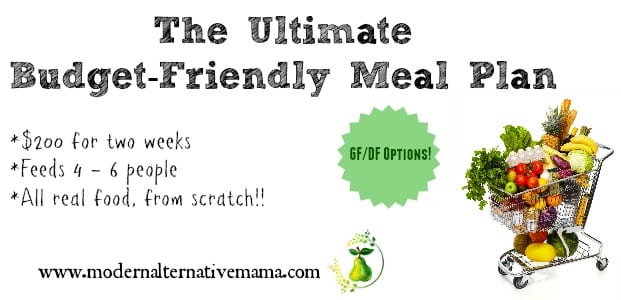
This is the final post in The Nourished Grocery Budget series. It might be kind of the most important. I’ve been sharing roadblocks to saving money — frugal tips for snacks and treats, some of my favorite budget-friendly recipes, and I even took you on a tour of my kitchen and how I store my bulk purchases in a small space.
Today, we are going to put it all together into an amazing ultimate budget-friendly meal plan. Everything you need to get your costs down, increase your family’s nutrition, and stretch the best seasonal ingredients. Delicious, fresh, healthy food on a budget. Real world plan.
This is a full two-week plan, because that’s how I create my meal plans (and how often I shop). I’ve included three meals per day, plus some snack/treat options, and a complete shopping list (with suggestions on how/where to purchase to get the best deals). I’ve even included suggestions for GF/DF swaps where needed so that our friends with allergies can use this plan too. This is your ultimate guide.
It’s my hope that with this series and this final plan, you can begin to do this for your own family on a regular basis, and see your grocery budget become significantly lower. Are you ready?

The Ultimate Budget-Friendly Meal Plan
WEEK 1
Monday
- B– English muffins with honey and butter (swap for smoothie if GF)
- L– Baked potato soup w/cheese and bacon (use coconut milk and arrowroot powder to thicken if GF/DF)
- D– Spaghetti with meat sauce, tossed salad (use GF pasta if needed)
- Snack/treat – Fruit juice popsicles
- Notes: Use any fruit juice to make popsicles (freeze in ice trays with toothpicks for sticks if you don’t have molds). Make a double batch of English muffins — do it ahead of time and freeze.
Tuesday
- B– Yogurt with soaked granola
- L– Hummus and fresh veggies
- D– Chicken and wild rice soup
- Snack/treat– Strawberry lemonade
- Notes: To save more money, use only brown rice in the soup instead of wild rice. Make extra hummus to have for snacks. Keep some garbanzo beans whole for another snack later in the week. Make your own yogurt or look for plain yogurt on sale and add honey or maple syrup yourself.
Wednesday
- B– Apples with nut butter
- L– Spaghetti with tomato-basil sauce (brown rice pasta if GF)
- D– Marinated chicken, scalloped potatoes, Caesar salad (serve roasted potatoes if DF)
- Snack/treat: Chocolate avocado pudding
- Notes: Make extra Caesar dressing and store in the fridge overnight. Start the chicken marinating in the morning (in the fridge); this can also be frozen ahead of time and taken out to marinate as it thaws. Save some chicken for the next day’s lunch.
Thursday
- B– English muffins with scrambled eggs and cheese (sandwich) (just eggs with fruit if GF/DF)
- L– Chicken Caesar wraps
- D– Baked beans with veggies and added sausage
- Snack/treat– Fresh fruit with whipped cream (nut butter if DF)
- Notes: Use the leftover chicken and Caesar dressing for the wraps. Make the tortillas ahead of time and keep them frozen (you’ll use more next week). Try cooking the scrambled eggs inside of metal cookie cutter to be perfectly sandwich-sized. Add 1 lb. of sausage to the baked bean recipe (cut it down to 1/2 to save money). Make your own whipped cream from heavy cream (you’ll use it again next week).
Friday
- B– Pumpkin muffins (or baked pumpkin pudding if GF/DF)
- L– Leftovers
- D– Mexican chicken soup
- Snack/treat– Crispy beans
- Notes: Make extra pumpkin muffins for snacks or freeze them. Add 1 c. dry pinto beans (soaked overnight) to the soup to stretch it further.
Saturday
- B– Soaked pancakes (or banana pancakes if GF/DF)
- L– Chicken and potatoes
- D– Mexican rice and beans
- Snack/treat– Fresh orange slices
- Notes: Start the pancakes soaking on Friday night. Cook them all Sat. morning and set aside some for Sun. morning. Soak black beans starting Friday night or early Saturday morning (at least 8 hours ahead).
Sunday
- B– Leftover pancakes, smoothie
- L– Broccoli cheddar soup (swap for garden vegetable if dairy-free)
- D– Taco salad
- Snack/treat– Banana slices with nut butter
- Notes: Use leftover rice and beans from Sat. in the taco salad — meat too, if available. Make smoothies with water and your favorite mixed frozen fruit — add pineapple, mango, or raw honey to sweeten if needed.
WEEK 2
Monday
- B– Berry banana oatmeal
- L– Grilled cheese sandwiches, carrot sticks (swap for garden vegetable soup if GF/DF)
- D– Beef tips with mushrooms and mashed potatoes, peas
- Snack/treat– Spring herbal tea with honey
- Notes: Soak the oatmeal starting on Sunday night to cut down on cook time. Bake bread over the weekend to use for grilled cheese (try this multi-grain bread). Use less meat and more stock, onions and mushrooms for the beef tips to save money. Cook a whole chicken in a crock pot; remove and shred the meat for meals later in the week, and return the bones to the crock pot to make stock.
Tuesday
- B– Green smoothie
- L– Chicken alphabet soup (add alphabet pasta to chicken veggie soup)
- D– Pizza (soaked crust + favorite toppings; use grain-free tortillas and Daiya or no cheese if GF/DF)
- Snack/treat– Apple slices and whipped cream (or nut butter for dairy-free)
- Notes: Start the pizza dough in the morning; add yeast around 4 PM for a 6 PM dinner time. Use chicken stock and some of the shredded chicken (about 1/3) for the soup.
Wednesday
- B– Scrambled eggs with cheese
- L– Pizza bread sticks (or leftover pizza)
- D– Vegetable beef soup (use stew beef)
- Snack/treat– Lemonade popsicles
- Notes: Make lemonade with lemon juice, water, and honey and freeze in ice cube trays if you don’t have popsicle molds. Add white navy beans to the vegetable beef soup to stretch it further if desired.
Thursday
- B– Maple cinnamon granola bars
- L– Leftover soup + tossed salad
- D– Garlic-butter salmon, cheesy potatoes, broccoli (swap roasted potatoes if dairy-free; use avocado oil for salmon)
- Snack/treat– Fresh strawberries
- Notes: Make extra granola bars for snacks (one batch makes about a dozen).
Friday
- B– Toast with nut butter
- L– Cheesy potatoes (leftover)
- D– Mexican pork roast, tortillas, salsa, rice + favorite toppings (salsa, cheese, onions, etc.) (swap for grain-free tortillas)
- Snack/treat– Strawberry yum-yum (use coconut whipped cream for dairy-free)
- Notes: Make strawberry yum-yum ahead of time. Keep frozen for extra treats (one tray makes about 12 servings). Make the pork roast in the crock pot, starting in the morning.
Saturday
- B– Soaked coffee cake
- L– Leftover pork roast, tortillas, rice, etc.
- D– Chicken and gravy with mashed potatoes (use arrowroot for the gravy for GF)
- Snack/treat– Fresh veggies or chips and guacamole
- Notes: Start the coffee cake on Friday night. Mix shredded or chopped chicken with gravy and pour it over mashed potatoes — add another veggie if desired, or mix carrots and peas into the chicken and gravy. Use the remaining chicken from the whole chicken + stock to make gravy.
Sunday
- B– Eggs and sausage fry, fruit salad
- L– Leftover chicken and gravy, biscuits (or use almond flour for GF option)
- D– Taco potatoes
- Snack/treat– Fresh fruit with chocolate fudge sauce
- Notes: Cook 1 lb. of sausage and mix in a dozen eggs (plus veggies if desired). Mix apples, strawberries, orange sections, and banana slices for fruit salad — top with a little honey if desired.
Grocery List and Shopping Tips
Meat/Dairy
- 3 lbs. ground beef ($15)
- 1 whole chicken ($9)
- 1 2 – 3 lb. pork roast ($8)
- 2 lbs. salmon ($9)
- 2 lbs. stew beef ($8)
- 5 lbs. chicken leg quarters ($5)
- 2 lbs. chicken breast ($10)
- 2 lbs. sausage ($8)
- 1 lb. bacon ($5)
- 2 gal. milk ($10)
- 2 lbs. butter ($8)
- 1 quart yogurt (unless you make your own) ($3)
- 3 doz. eggs ($9)
- 1 lb. cheddar ($4)
- 1 lb. pepper jack cheese ($5)
- 1 lb. mozzarella ($4)
- 1 pint heavy cream ($3)
- TOTAL: $123
Produce
- 1 bunch bananas ($2)
- 1 bag apples ($2)
- 2 – 3 oranges ($2)
- 2 lbs. strawberries ($4)
- 10 lbs. potatoes ($5)
- 2 lbs. peas ($2)
- 3 lbs. broccoli ($3)
- 2 avocados ($2)
- 2 lbs. onions ($1)
- 1 bulb garlic ($1)
- 5 lbs. carrots ($5)
- 2 lbs. lettuce ($4)
- 8 oz. cremini mushrooms ($1)
- 2 green peppers ($1)
- 1 bunch spinach or kale ($1)
- 1 bag lemons ($3)
- TOTAL: $39
Frozen
- 1 lb. strawberries ($2)
- 1 lb. green beans ($1)
- 2 lbs. mixed fruit ($6)
- Total: $9
Pantry
- 1/2 lb. black beans ($1)
- 1/2 lb. pinto beans ($1)
- 1 lb. garbanzo beans ($2)
- 1 jar tahini ($4)
- 1 jar peanut or almond butter ($4)
- 4 lbs. brown rice ($4)
- 5 lbs. white whole wheat flour ($3)
- 2 lbs. raw honey ($10)
- 1 pint maple syrup ($5)
- 1 can pumpkin ($1)
- 3 lbs. oats ($3)
- 1 lb. spaghetti ($1)
- 1 can crushed tomatoes ($1)
- TOTAL: $40
Staples
- Salt
- Baking soda
- Cinnamon
- Cumin
- Chili powder
- Oregano
- Basil
- Olive oil
- Vinegar (preferably balsamic or red wine)
TOTAL: $211 (for two weeks of meals, to feed 4 – 5 people)
Many of these items, especially produce, can be picked up at Aldi (many locations also have grass-fed beef now). Frozen items are often cheap at Costco, as well as a lot of the pantry items. If you purchase at Costco, you’ll buy larger packages and therefore spend more (but less per lb.), but it will last for more than just two weeks.
I check my local Meijer (a regional chain), Wal-mart, or other grocery stores to fill in what I can’t buy at Costco or Aldi. I purchase most spices either at bulk stores locally or online at Mountain Rose Herbs.
I’m assuming that meats are mostly pastured/organic, dairy is organic and/or raw, and most produce is organic (I don’t tend to buy onions organic because they are so low on the dirty dozen list). Most pantry staples are organic, although you may need to spend a little more for some of them. Even if you went 100% organic I think it could be accomplished for under $250.




I liked this but definitely not enough veggies. 🙂
I decided to try this exact menu and see if it really worked well for two weeks. I love the idea and the concept, but ran into a few issues. The first was that all my meat/eggs/dairy were twice as much as the listed prices here. 🙁 But as I was cooking through the two weeks I found that there were many ingredients from the linked recipes that were not included on the shopping list (corn, white beans, wine, celery, cilantro, etc..there were quite a few actually). Several of the links are no longer working so I had to skip a few different menu options, and many of the recipes on Tradishen were unclear in the directions or measurements. I also found some of the finished meals to be too small for my family of four. However, the things that worked all tasted good and there was nothing that we didn’t like. I actually did shop for two weeks and then (almost) did not have to return to the store for two weeks so that was very nice. And while the initial cost was higher than suggested here, I did feel like I saved money following this menu. Over all, great concept, helpful, fun, but needs some tweaking.
This is a great idea! However, I know this would not be enough food for my family of 5. I do think meal planning and simple meals are the key to keeping food costs down. We spend about $500 each month on food, some grass fed and organic, some not. We are gluten free but not dairy free. We also are nightshade free which adds an extra element of challenge to meal planning. I’ve discovered that creating a capsule menu is the key for keeping meals simple, easy and keeping my grocery budget under control:
https://www.turn2thesimple.com/capsule-menu/